
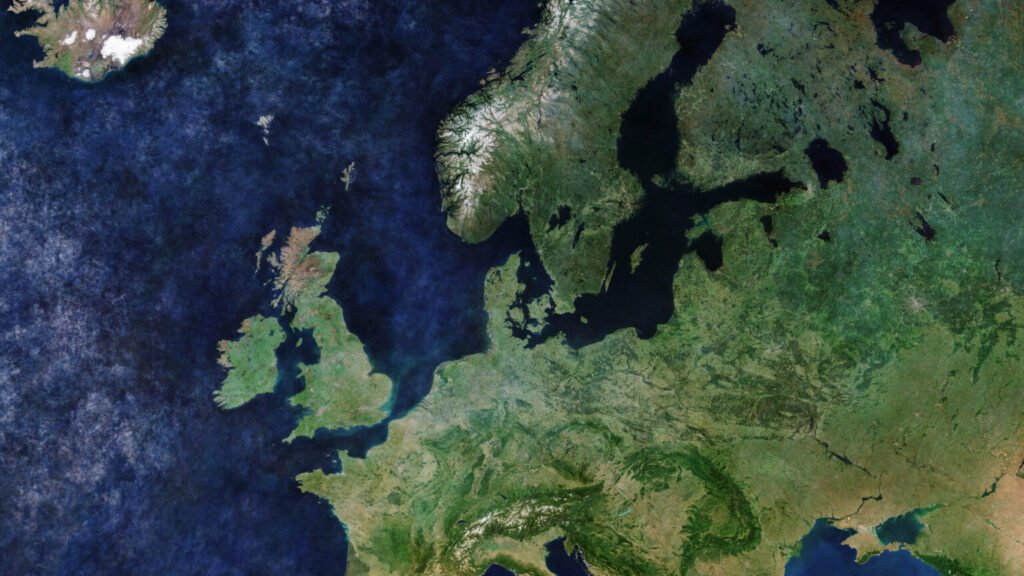
Russian satellites have been identified as the source of mysterious, short-term spikes in disruptions to the Global Positioning System (GPS) across Europe, marking a rare instance of man-made space interference. This discovery stemmed from an investigation detailed in a previous report from June 2, conducted by Todd Humphreys and his student Zachary Clements from the University of Texas at Austin, along with Argyris Kriezis from Stanford University.
Researchers found 75 days with at least one large-scale GPS disruption event affecting global navigation satellite systems (GNSS) between January 2019 and April 2026. These disruptions, which lasted less than 10 seconds each, were simultaneously recorded by ground stations across Europe, from Norway to Spain and Poland, and also reached Greenland and Canada. They coincided with the GPS L1 frequency range, centered on 1575.42 megahertz, which is primarily used for transmitting signals by GPS and other GNSS constellations. However, there remains uncertainty regarding the intent behind such disruptions and the potential for their use as a more powerful GPS jamming weapon in the future with continental coverage.
Details of the study and discovery
Researchers identified the characteristics of high-power disruptions by analyzing public data from ground stations equipped with GNSS receivers. According to Humphreys, the recorded disruptions were “of a continental scale” and occurred mostly on Tuesdays, Wednesdays, and Thursdays during working hours in Europe. Humphreys and his team calculated that the source must be located at an altitude of at least 1,200 kilometers above the Earth. Initially, researchers could not advance their analysis because they only had data processed by GNSS receivers and needed to capture raw radio signals from the source of the disruption.
In September 2025, researchers sought assistance from the broader community at the Institute of Navigation conference in Baltimore, Maryland. After several months, Humphreys received a crucial tip that raw signal data of the disruption had been captured by stations in Amsterdam, the Netherlands, and Trondheim, Norway, during a disruption event on February 11, 2026.
Precise identification of the source
By studying the time difference in the signal’s arrival at the two different stations (Amsterdam and Trondheim), Humphreys and Clements calculated what they termed a “quasi-hyperbolic surface”. This surface extends tens of thousands of kilometers into space, and the satellite source of the disruption had to be located within it. According to Veritasium, the error represented by the thickness of this “quasi-hyperbolic surface” was only five meters.
Source: ArsTechnica